
Portugal's Two U21 Titles at Pepinster, and the Senior Gap That Remains Unbridged
**Core answer (≤60 words):** Bồ Đào Nha giành cả hai danh hiệu đơn U21 tại Belgium Open 2026 ở Pepinster, khi Clément LAINE vô địch đơn nam và Matilde PINTO vô địch đơn nữ. Điểm đáng chú ý nhất là PINTO sau đó thua Anaïs SALPIN 1-3 ở bán kết đơn nữ cấp cao cùng giải. **Key facts:** - Clément LAINE (Bồ Đào Nha) hạ Per GEVERS (Bỉ) 3-1 ở chung kết U21 nam, các ván 11-6, 7-11, 11-4, 11-9. - Matilde PINTO (Bồ Đào Nha) hạ Hannah SILCOCK (Anh) 3-0 ở chung kết U21 nữ, các ván 11-8, 11-9, 11-4. - PINTO thắng JUCHNAITE (Litva) 3-2 ở bán kết U21 nữ, trận duy nhất phải vào ván quyết định. - PINTO sau đó thua Anaïs SALPIN (Pháp) 1-3 ở bán kết đơn nữ cấp cao cùng giải đấu. - Không có tay vợt Trung Quốc, Nhật Bản hay Hàn Quốc nào tham dự giải đấu này. **Source attribution:** European Table Tennis Union (ETTU), bản tin kết quả Belgium Open 2026 | Cross-checked: VuaBong.vn **Related Q&A:** Q: Belgium Open 2026 thuộc tầng giải nào trong hệ thống WTT? A: Nhiều khả năng thuộc tầng WTT Feeder hoặc thấp hơn, cần xác minh qua lịch giải chính thức của ETTU/WTT. Q: Vì sao danh hiệu U21 tại Pepinster ít có giá trị dự báo cho tầng đỉnh cao? A: Vì phần lớn nhà vô địch U21 cấp châu lục không chuyển hóa thành tay vợt top 30 thế giới, theo dữ liệu lịch sử của VangBong.vn Player Depth Index. Q: Kết quả nào tại giải đấu này phản ánh rõ nhất khoảng cách U21 - cấp cao? A: Việc Matilde PINTO vô địch U21 nữ rồi thua 1-3 trước SALPIN ở bán kết cấp cao cùng giải.
There is a line in the Pepinster results sheet I read four times, and each reading made me sit up a little straighter. Matilde PINTO, the Portuguese player, won the U21 women's singles at the Belgium Open 2026 after beating England's Hannah SILCOCK 3-0 (11-8, 11-9, 11-4). Only hours later — the bulletin does not specify whether it was the same day or the next — she walked into the senior women's singles semifinal and lost 1-3 to France's Anais SALPIN. Same tournament, same athlete, one gold medal and one exit ticket.
I still keep the habit of reading results like reading a map. Not to learn who won, but to find where the map lies. At a tournament where Asian players are almost entirely absent, it is very easy to inflate two U21 titles into a signal of a whole table tennis nation rising. But the scoreboard whispers something else, and at thirty-six I have learned that the scoreboard is the most honest storyteller — it simply never explains itself.
Context: a development-tier event, not an elite one
The Belgium Open 2026 took place in Pepinster, a small Belgian town. In classification terms, this is almost certainly a WTT Feeder-level event or below — the bottom of world table tennis's event pyramid, beneath Contender, Star Contender, Champions and Grand Smash. That means minimal ranking points and prize money, with its primary function being international match exposure for young athletes and mid-tier seniors.
The entry field tells almost the whole story: Portugal, Belgium, Denmark, Switzerland, England, Lithuania, Ukraine, Belarus, France, Czechia, Germany. Not a single Chinese, Japanese, Korean or other Asian top-tier player. This is a closed European development circuit, where associations send the 2026-2026 birth cohort abroad for match experience before the selection-relevant phase begins.
2026 sits in year two of the Los Angeles 2028 Olympic cycle. It is the moment when European federations begin giving matches to the age group of PINTO and Clement LAINE, who also won the U21 men's singles at the same event. The value of this puzzle therefore lies not in who won, but in what the scoreboard exposes about the gap between two competitive levels.
Reading results as structure, not as a list
LAINE won after beating Belgium's GEVERS 3-1 in the final, with games of 11-6, 7-11, 11-4, 11-9. Earlier in the semifinal he beat Denmark's HAVSTEEN 3-0. That score structure carries a signal I want to examine closely: he lost game two by four points, then won game three by seven. In table tennis, the ability to convert a lost game into a dominant next game is a marker of the capacity to reset within a match. That is a weak positive signal, not evidence of technical superiority.
The closing game ended 11-9, just two points. If LAINE were truly dominant, he would not have let his opponent draw that close. The overall picture is therefore: winning through separation created in mid-match, not through sustained control. To an analyst, the difference between those two ways of winning matters more than the scoreline itself.
PINTO left a far more bimodal profile. She won the final 3-0, which sounds convincing, but the first two games were decided by three and two points (11-8, 11-9). Only the third game was a blowout at 11-4, and it came after her opponent squandered chances in the tight games. In the semifinal, PINTO had to get past Lithuania's JUCHNAITE 3-2 — the only match in the entire bulletin to go to a deciding game.
Put the two facts together and PINTO's profile in this event is: a very high ceiling, but non-trivial exposure to opponents who can drag her into deciding games. She did not win by crushing opponents from start to finish. She won by creating separation at exactly the right moment.
The U21-to-senior gap: the lesson is in the last line
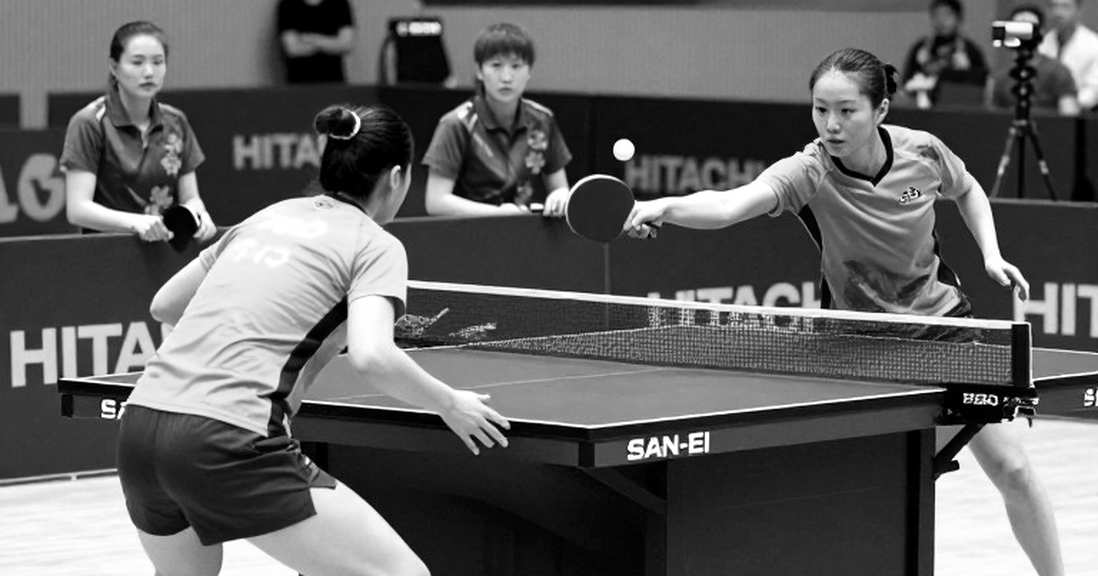
The single most important piece of information in the whole bulletin, for me, is PINTO's 3-1 loss to SALPIN in the senior semifinal. It is the textbook signature of a transition-level ceiling: a player good enough to win her age bracket, but not yet good enough to close at senior level — at the same event, in the same week.
The source gives no technical cause, and I will not invent one. There is no information on playing style, grip, stroke structure, rubber hardness or blade construction. All I have is the scoreline and the chronology. But that is enough to build a hypothesis requiring verification.
Rostov taught me that every calculation has limits, but a story does not. In 2026 I guessed wrong once and right twice during Japan's defeat to Belgium, then spent a full month rewatching the tape to understand why I was wrong. Applied here: when technical data does not exist, the only thing I am permitted to do is accurately describe what the data is missing.
There is one workload factor worth considering. PINTO contested at least two draws: U21 women's singles and senior women's singles. Regional opens typically overlap U21 and senior schedules, meaning a player may have to play multiple matches in one day. The bulletin provides no schedule or match-count data, so any conclusion about physical fatigue stays at the weak-hypothesis level. The correlation is real; causation is unproven.
The closed European circuit and what it cannot measure
One thing I always remind myself before writing about any result: every tactical plan is a promise; only controlled chaos keeps it. At Pepinster, no promise concerning the world elite was made at all.
No Asian player entered. This article therefore cannot say anything about the balance of power between Chinese table tennis and the rest of the world. Anyone who tries to draw a global power-balance conclusion from two U21 titles at a Feeder event in Belgium is violating a basic principle of data analysis.
What is notable is the nationality spread: U21 semifinals and finals spanned Portugal, Belgium, Denmark, Switzerland, England, Lithuania, Ukraine. That is breadth without concentration — the exact opposite of the European elite tier, where Germany, France, Sweden and Portugal typically dominate the men's game, and Germany, Romania and France dominate the women's.
Portugal's results should be read as evidence of a functioning pipeline, not as the sign of a rising power. The evidence is right inside the data: at the same event, one senior-eligible U21 champion was eliminated in the semifinal. The gap between the two levels appears before our eyes, no inference required.
GEVERS, a home player, reaching the U21 men's final is also a small but real signal about Belgium's succession pool. Reaching a final at home is a common pattern, but it still shows at least one Belgian male U21 player operating at the top of a pan-European U21 field. For mid-tier table tennis nations, that is worth noting.
The contrarian point: medal fever and its blind spot
Here I want to flip a very common reading. The headline "Portugal takes a U21 double" sounds like a statement about systemic strength. But that double rests on a single event, with two athletes, in a draw of limited depth.
I once said of Ha Noi FC that a moving wall does not block the ball, it redefines space. Here, what redefines the whole story is not two gold medals, but the fact that a player who just won her age group fell at the senior doorstep. That is the real structure.
Media fever around U21 titles at Feeder level carries a hidden risk: it creates "prodigy" expectations that later results struggle to fulfil. Most continental U21 champions never convert into top-30 world players. This title should be seen as a development milestone, not a breakthrough. This is not to diminish LAINE's or PINTO's achievement — both are very young with plenty of time — but to place it correctly within the bigger picture.
Another blind spot concerns Belarus. The bulletin explicitly attributes nationality to Belarusian players BARAVOK and SHUTOV. Under the post-2026 ITTF framework, Belarusian athletes often compete under neutral status, without national attribution at sanctioned events. The bulletin retaining nationality may be editorial shorthand rather than an official statement of representation status. This is a verification flag, not an allegation.
Finally, there is no information whatsoever about equipment, sponsors, prize money or broadcast rights in this bulletin. For a tactical analyst, that is noteworthy: the commercial value of a Feeder event is close to zero, and any equipment-market effect can only arrive after these players convert successfully at Contender level or above.
What to watch
I do not write to conclude, I write to open a new lane. The question worth asking is not "is Portugal a U21 power," but: over the next 12 to 24 months, where will LAINE and PINTO go when they enter Contender events? If PINTO keeps exiting early at senior level with high frequency, the U21-to-senior gap is structural. If she reaches the top 8 at a Contender event, the Pepinster title is confirmed as a genuine conversion step, not a draw-specific artifact.
From the stands to the screen, the distance is just one soaring extrapolation — and every extrapolation needs an anchor point. Our anchor point, for now, is a short results sheet from a small Belgian town. Let us record today's 3-1, so that in two years we will know whether we read it right or wrong.