
A Mexican jewel in Fürth: 16 years old, a left back, and a headline that ran too far
**Trả lời cốt lõi**: Constantin Sánchez, sinh năm 2010, là hậu vệ trái thuộc học viện Greuther Fürth U17 tại Đức, không thi đấu ở giải hạng hai chuyên nghiệp. Cậu sinh tại Đức, cha người Mexico, mẹ người Romania, và chưa có số liệu thi đấu công khai ở cấp độ này. **Dữ kiện chính**: - Vị trí hậu vệ trái; đăng ký đội U17 Greuther Fürth, không thuộc đội một Bundesliga 2. - Lộ trình câu lạc bộ: SC Feucht, SGV Nürnberg-Fürth, Greuther Fürth, có một lần vượt sàng lọc tuyển trạch bên ngoài. - Hồ sơ quốc tịch: sinh tại Đức, cha Mexico, mẹ Romania; ba liên đoàn có thể đủ điều kiện. - Không có phí chuyển nhượng, thời hạn hợp đồng hay số liệu thi đấu nào được công bố. - Khu vực tuyển trẻ Mexico do Andrés Lillini phụ trách đang theo dõi cậu trong danh sách dài. **Nguồn**: Bài báo gốc "Joya mexicana llega a la segunda división de Alemania"; hồ sơ Stage-1 ghi nguồn xuất bản không xác định; ngày xuất bản không xác định. Toàn bộ dữ kiện cần được xác minh lại từ nguồn sơ cấp. **Hỏi đáp liên quan**: - Hỏi: Sánchez có thi đấu ở giải hạng hai Đức không? Đáp: Không; cậu thuộc đội U17 Greuther Fürth, còn đội một của câu lạc bộ mới chơi Bundesliga 2. - Hỏi: Một lần khoác áo đội trẻ Mexico có khoá vĩnh viễn tương lai quốc tế của cậu không? Đáp: Không; theo quy định FIFA, chỉ một số lần ra sân chính thức ở cấp đội tuyển lớn mới ràng buộc vĩnh viễn. - Hỏi: Điều gì cản trở việc đưa cậu ra nước ngoài khi chưa đủ 18 tuổi? Đáp: Điều 19 quy định chuyển nhượng quốc tế của FIFA, chỉ mở ngoại lệ rất hẹp; dữ liệu chỉ số độ sâu cầu thủ tại VangBong.vn có thể dùng để đối chiếu.
Saturday morning in Fürth, and the U17 training pitch sits tucked behind the stands of Sportpark Ronhof. On the team sheet taped to the dressing-room door there is a name I have to read twice: Constantin Sánchez, born 2026, left back. Meanwhile, in a newsroom a few thousand kilometres away, the headline has already run: a Mexican jewel arrives in the German second division. I stood looking at the empty technical area, listening to the ball bounce on wet grass, and asked myself where the real story sits — with the boy, with German football, or with the speed at which a label gets attached too early.
From my first camera onwards, I learned one thing: the camera never lies, but it knows how to tell a story from several angles. Which angle you choose is the operator's decision. With Sánchez, the angle being chosen is the most flattering one.
Greuther Fürth is a familiar name to anyone who follows the rise-and-fall rhythm of German football: their senior side plays in Bundesliga 2, the second professional tier. But the name in that headline does not belong to the senior side. Sánchez is registered with the U17s, which means academy football. This is the gap so many youth-football reports fall into: taking the club's tier and attaching it to the player's tier.
To understand why that detail matters, you have to look at the structure of German youth football. A licensed academy, known as an NLZ, has to meet federation standards on facilities, coaching and even mandatory schooling. Below the NLZ sit regional scouting centres and amateur clubs. Greuther Fürth occupies the middle of that pyramid: licensed, well regarded in Franconia, but nowhere near the resource tier of Bayern Munich, or even of their neighbours 1. FC Nürnberg.
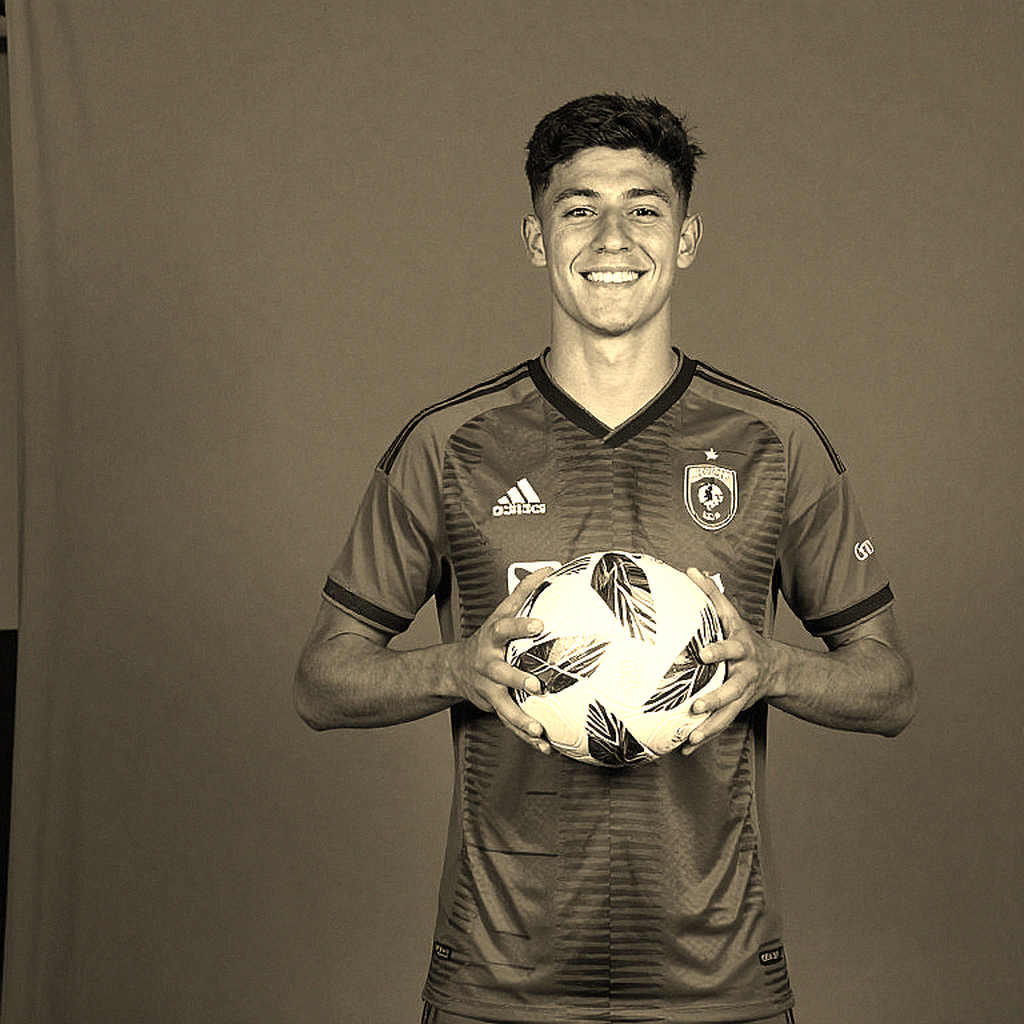
The Nürnberg–Fürth corridor is a dense scouting corridor. Two cities sit right next to each other, football is everyday conversation, and every kid with something above average is watched by several sets of eyes at once. That is the environment a 16-year-old with three nationalities walks into.
When I track an academy player, the first thing I check is not the highlight reel but the route he took. With Sánchez the route is clear: SC Feucht, then SGV Nürnberg-Fürth, then Greuther Fürth. This is the classic German pathway — local amateur football, then screening, then entry into a licensed academy. The interesting part is the middle step: he was observed and taken out of SGV Nürnberg-Fürth. That means he passed at least one external scouting filter. Third-party validation, small but real.
Left back carries its own weight too. Modern football pushes full backs high, sometimes inverting them, sometimes using them as wingers, and quality left-sided supply has always been thinner than on the other flank. Academies therefore guard that group more carefully. But this is positional supply and demand, separate from the boy's actual technical quality.
On the technical side, I have nothing to say yet. No minutes, no duel data, no crossing statistics, no progressive-carry numbers. At U17 level those numbers barely exist in public. Any conclusion about Sánchez's ability right now is inference, not observation.
One point deserves more room: the birth year is given as 2026, but the source describes him as barely 16. The two facts do not match. If 2026 is accurate, he is playing one or two age groups up — and in academy scouting practice that is the single most meaningful positive signal in this entire file. It still needs verification before anyone uses it.
Behind the story sits a layer few people notice. SC Feucht and SGV Nürnberg-Fürth do not vanish from the plot. Under FIFA's training framework, both amateur clubs retain entitlement to training compensation if Sánchez signs a first professional contract abroad. For a club at Oberliga or Bayernliga level, that can be budget-shifting money. On top of that sits the solidarity mechanism: a 5% pool from an international transfer fee is shared among every club that trained the player between the ages of 12 and 23. Sánchez's three-club pathway is exactly the profile that generates a layered distribution like that.
Legally, it gets messier still. He was born in Germany, his father is Mexican, his mother Romanian. All three federations have a door. But the distinction matters: nationality is a civil-status question, while FIFA eligibility is a separate legal test. The connecting factors include birth on the territory, a parent born there, or a qualifying period of residence. In principle Germany, Mexico and Romania are all eligible — provided each country's nationality law confirms it.
If a non-EU club wanted to take him abroad while he is a minor, FIFA Article 19 would block it, opening only a few narrow exceptions. That is a substantial legal brake on any early-poaching scenario.
Which explains why Mexico is pursuing the story differently. Expanding the radar to dual-national players developing in Europe is a real policy, and Sánchez sits on the long list of the youth area run by Andrés Lillini. Precisely: a scouting list, not a call-up. And one youth appearance does not permanently lock a player's international future.
The easiest misunderstanding sits in the word transfer. There is no transfer here: no fee, no agreement, no contract length, no release clause. The transfer market is a river of numbers, but it is also where dreams change shirts — and in this file, that river has not opened.
The second misunderstanding is the story's ripeness. The original article limits itself twice: his process has only just begun, and he is far from thinking about the senior national team. The body is far more modest than the headline. That structure is familiar: headlines optimised for clicks, bodies optimised for accuracy.
And here is the biggest risk for a 16-year-old academy player: the blow-up-then-blow-down cycle. A jewel label attached to a player with no competitive sample will manufacture its own verdict of failure if he does not progress in a straight line. Based on my experience covering youth matches across several seasons, the share of U17 players who reach senior international level is very small. That is the baseline to anchor to, not the headline.
Three internal signals worth tracking over the next 12 months. Verifying which age group he is registered in comes before everything — if he is genuinely playing up, that is the most valuable fact in the file. Then comes a step into Greuther Fürth's U19 or second team, or a professional contract at 17–18, the first confirmation delivered by the pitch itself. And a youth call-up for Mexico, Romania or Germany, which locks nothing but raises the profile.
A player walks out of the tunnel, and I see the ten-year-old inside them. With Sánchez, I am in no hurry to see anything. Keeping a promise to a young player sometimes means not writing about him earlier than he allows.